Cold Brew Tea at Home: Time, Flavor & Food-Safety Tips

Cold brew tea trades hot water and a short steep for cool water and a longer extraction. The method is simple, but it needs more care than leaving tea bags in a pitcher on the counter.
Start with clean equipment, potable water, a refrigerator at 40°F (4°C) or below, and a small batch. Time, tea type, water volume, and the number of bags all change the finished cup.
Cold brew tea is not the same as iced tea
Cold brew tea steeps in cool water under refrigeration. The tea is never intentionally brewed hot.
Iced tea usually begins with hot water. It is then cooled or poured over ice, sometimes as a stronger concentrate to account for melting. Hot and cold water do not extract tea compounds at the same rate, so these methods can produce different aromas, bitterness, body, and color even when they use the same tea.
That distinction also matters when reading a package. If a tea's directions specify hot or boiling water, follow them and chill the finished infusion instead of assuming it is suitable for cold extraction. This guide does not establish cold-brew directions for every green, black, oolong, or herbal product.
What research says about cold-brew flavor
A 2025 Food Chemistry study examined one green tea brewed at 4°C and found that its flavor developed gradually while several bitter compounds extracted more slowly than under the study's hot-brew condition. A separate consumer study of seven Taiwanese teas found that cold infusions differed according to the teas' processing and fermentation levels.
These studies used specific teas and conditions, not a universal timetable. Oolong, fine-cut green tea, and a dense root infusion need not behave alike.
Use research as a reason to taste and adjust—not as proof that one steeping time works for every tea.
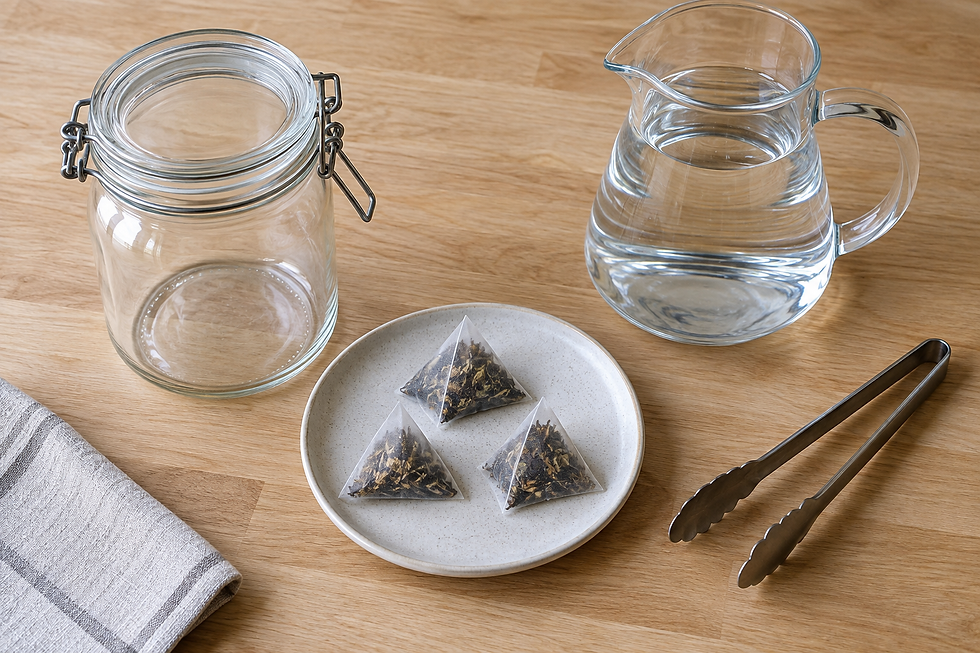
Illustrative setup only; the formula below uses two sachets.
Proposed small-batch refrigerator formula
Yield: About two 8-ounce servings Status: Proposed culinary starting point; not tested Tozzy package directions
You will need
2 sealed pyramid tea bags
2 cups (475 mL) potable cold water
1 clean, food-safe lidded jar or pitcher with at least 3 cups of capacity
Clean spoon or tongs
Ice made from potable water, optional at serving
If using Tozzy pyramid bags, keep each sachet intact. It should remain sealed, pyramid-shaped, completely stringless, tagless, and stapleless. Do not cut it open.
Method
Read the package first. Check the ingredients, caffeine statement, cautions, and preparation directions. If the package requires hot water or gives different cold-preparation instructions, follow the package.
Prepare a clean workspace. Wash your hands. Wash the jar, lid, and utensil with hot, soapy water, rinse well, and allow them to drain or dry on a clean surface.
Measure the water. Add 2 cups of cold potable water to the clean container.
Add the tea bags. Place two intact pyramid bags in the water with clean hands or a clean utensil. Cover the container.
Refrigerate immediately. Put the covered container directly into a refrigerator maintained at 40°F (4°C) or below. Do not use the countertop for the long extraction.
Begin with six hours. After six refrigerated hours, remove the bags with a clean spoon or tongs. This duration is a proposed flavor starting point, not a safety guarantee or universal steep.
Serve cleanly. Pour a portion into a clean glass, over ice if desired. Cover the remainder and return it to the refrigerator promptly rather than leaving the pitcher on the table.
Adjust the next batch. If the tea is too light, use less water, add a bag, or extend the refrigerated steep when consistent with the product directions. If it is too strong, shorten the next steep or dilute the serving.
Avoid repeatedly opening the jar to sip directly from it. Each contact with hands, cups, utensils, fruit, or other ingredients creates another opportunity for contamination.
How long should cold brew tea steep?
Six hours is a useful experimental starting point for this small batch, not a rule. Leaf size, bag fill, tea style, ratio, and refrigerator temperature all affect extraction.
Record the bags, water volume, and refrigerated time so you can adjust one variable in the next batch.
Leaving the bags in indefinitely does not guarantee better flavor or safety. Once the cup tastes balanced, remove them cleanly. Make another small batch instead of maintaining a “perpetual” pitcher.
Is cold brew tea caffeine-free?
No. Cold describes the extraction method, not the tea's caffeine status. The FDA explains that caffeine occurs naturally in tea and that amounts can vary by product and serving size.
Green, black, white, and oolong teas come from Camellia sinensis and contain caffeine. A cold-brew study may measure less caffeine than a particular hot-brew comparison, but that result depends on the tea, ratio, temperature, and time. It does not turn ordinary caffeinated tea into decaffeinated tea.
For a caffeine-free choice, use a product specifically labeled caffeine-free and still check every ingredient. Do not rely on “herbal” alone.
Food-safety habits for refrigerator cold brew
Cold brewing does not sterilize tea, water, or equipment. Refrigeration can slow microbial growth, but it is not a kill step and does not make poor handling safe.
Use these practical risk-reduction habits:
Start with potable water and clean, food-safe equipment.
Verify that the refrigerator is at or below 40°F (4°C); an appliance thermometer is more reliable than guessing.
Keep the covered container refrigerated throughout extraction.
Use a clean utensil to remove stringless bags and return the pitcher to the refrigerator promptly after pouring.
Add milk, plant-based beverages, citrus, herbs, or cut fruit to the individual glass at serving rather than storing them in the main batch.
Do not assign one universal shelf life to every homemade tea. Ingredients, handling, refrigerator performance, and product directions differ. Make a small amount and enjoy it promptly.
If the batch's time or temperature history is uncertain, the container was not clean, or contamination is possible, discard it.
Once perishable additions such as milk or cut fruit are involved, FDA guidance says they should not remain at room temperature for more than two hours, or one hour when the air temperature is above 90°F.
An unusual odor, film, fizz, cloudiness, or texture is a clear reason to discard a batch, but a normal appearance, smell, or taste does not prove that it is safe. The FDA explains that foodborne illness organisms can be present even when a food does not look, smell, or taste spoiled. When in doubt, throw it out rather than sampling it to decide.
Which tea should you try?
Begin with a tea whose package supports the method. A study of one tea cannot validate another. The Tozzy oolong brewing guide explains how temperature and time shape that style.
Do not assume every herbal tea belongs in a cold-brew pitcher. Roots, seeds, spices, blends, and flowers differ; some require hot water. For a hot-brew-and-chill alternative, see the butterfly pea flower iced-tea guide.
Build a cold tea routine thoughtfully
Cold brew rewards a little recordkeeping: start small, keep it refrigerated, taste after a measured interval, and adjust one variable in the next batch.
Browse Tozzy's current organic tea collection, then check the individual product page and current package for ingredients, caffeine information, cautions, and tea-specific directions. If cold preparation is not supported, brew it as directed and chill it instead.


Comments